
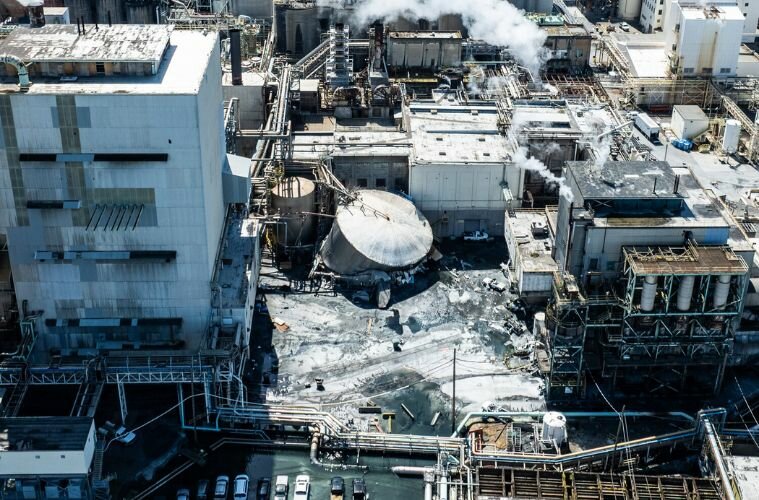
A 900,000-gallon white liquor tank implosion at Nippon Dynawave's Longview mill killed 11 workers on May 26. Federal investigators are on site as scrutiny mounts over the facility's safety record.

Investors call corporate water risk disclosure unfit for decision-making yet keep relying on it. As regulatory pressure builds and water stress accelerates, that tolerance is ending.

Prevalon’s HD5 AC shifts more storage work into the factory. The system is built to reduce field complexity, commissioning delays and project risk.

Pipestone XL's awaruite target skips smelting and HPAL processing, offering procurement teams a domestic nickel-cobalt alternative aligned with IRA content requirements.

Tier 1 buyers are discovering that subcontracted compliance failures move up the liability chain faster than most procurement frameworks were designed to handle.

USEFULL has launched its first senior living reuse program at The Glen. The model replaces disposable takeout boxes with tracked steel containers.

DartPoints acquired a 343,000-square-foot campus in Lexington, Kentucky, with an owned substation and a path to 70 MW, targeting AI, hyperscale, and neo-cloud demand.

Waste is moving from disposal cost to business asset. Circular systems can turn plastics, sludge and organics into energy, materials and resilient supply chains.

Idaho's April trade mission to Japan and Micron Technology's accelerated Boise fab timeline are positioning the state inside the semiconductor and AI supply chain buildout reshaping U.S. industrial geography.

The regulatory framework for industrial radiography involves multiple federal and state agencies, dose limits that carry criminal exposure if violated, and compliance failures specific enough that inspectors arrive with a checklist most field crews have never read.

OSHA's enforcement priorities have shifted, inspection weighting has evolved, and heat illness citations are expanding without a finalized federal standard, leaving many EHS programs misaligned with how inspections are actually being conducted in 2026.

The October 2026 TSCA reporting deadline and July TRI filing date are pulling PFAS into active regulatory scrutiny. Most facility programs are not ready for what follows the filings.

The numbers coming out of that program are not trending in a good direction, and the state's public dashboard is now one of the more detailed occupational disease tracking tools available anywhere in the country.

The California ISO Board of Governors approved 38 transmission projects totaling $6.7 billion to meet rising load demand and expand access to renewable energy basins across California by 2035.

Anderon will initially focus on wafer fabrication for superconducting qubit technology and supporting electronics, with plans to expand into other quantum computing approaches over time.

GAIA BioMaterials has gained European patent approval for PLA-free film materials. The compounds target compostable bags, aprons and other flexible uses.

House FY2027 energy and water bill advances at $58.5B, cutting grid and clean energy programs sharply while boosting nuclear defense and water infrastructure.

Mexico's CFE declared grid emergencies three times in summer 2024 and reserve margins hit 3% in May of that year. For manufacturers who relocated to Mexico, summer reliability risk was not in the original location analysis.

Wet bulb temperatures in the Gulf and South Asia are crossing physiological safety limits earlier each year. Most multinational heat protocols are not calibrated to where peak exposure actually occurs.

ABTC’s Nevada recycling facility posted record revenue and positive gross margin. The quarter shows early traction, though expansion risks remain.