
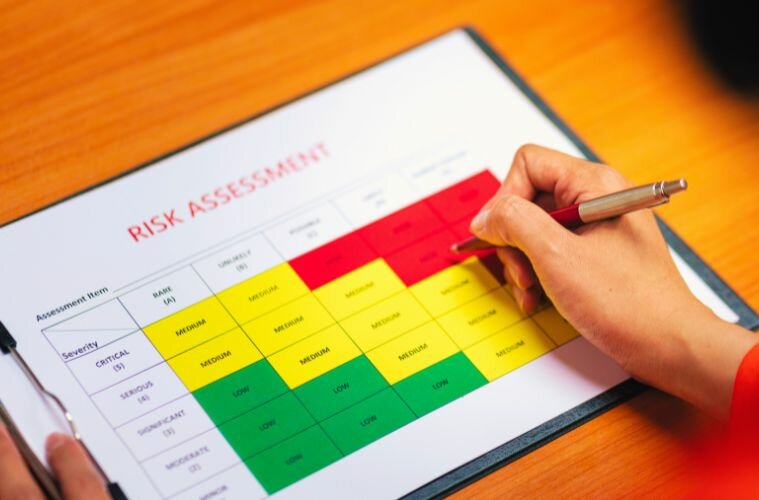
Most corporate risk registers still contain the familiar categories. Regulatory compliance. Energy costs. Supply chain disruption. Workforce safety. Climate exposure. Those categories remain relevant. What changed during Q2 was the relative weight of each one, and the speed at which several moved from manageable operational issues into strategic business risks.
Many organizations have not adjusted accordingly. The result is a growing disconnect between where executive attention is focused and where exposure is actually increasing. The companies most likely to navigate the second half of 2026 successfully are not necessarily the ones with the most sophisticated risk programs. They are the ones that have recognized the map itself has changed.
Heat Became an Enforcement Risk, Not Just a Weather Risk
For years, extreme heat was treated as an operational concern. Facilities teams monitored forecasts. EHS teams adjusted work schedules. Business continuity plans accounted for disruptions. That framework is no longer sufficient on its own.
Earlier this yera, the Occupational Safety and Health Administration (OSHA) updated and extended its National Emphasis Program (NEP) on heat-related hazards, effective immediately and running through 2031. The program targets 55 high-risk industries, including construction, manufacturing, warehousing, agriculture, and food processing. OSHA compliance officers are authorized to conduct proactive inspections whenever the National Weather Service issues a heat advisory, without waiting for a complaint or incident. Multiple states are advancing their own workplace heat standards in parallel, with California, Washington, Minnesota, and others already enforcing jurisdiction-specific requirements.
The implication is significant. Heat now carries enforcement exposure alongside operational exposure. Organizations are no longer managing employee safety during extreme weather events alone. They are managing the possibility of inspections, citations, and litigation tied to the adequacy of documented heat illness prevention programs. Companies that still view heat primarily as a seasonal scheduling issue may be underestimating the legal and financial dimensions of the risk heading into summer.
Grid Reliability Shifted From a Price Question to a Capacity Question
Energy security discussions have traditionally centered on price volatility. The challenge emerging across multiple regions is different in kind, not just degree.
According to NERC's 2026 Summer Reliability Assessment, published May 19, aggregate peak demand across all assessment areas increased by more than 11 gigawatts (GW) over 2025, exceeding the prior year's pace of growth. The grid added more than 58 GW of new generation capacity since last summer, yet NERC's director of reliability assessments was careful to note: "The improved conditions we're seeing shouldn't be interpreted as saying that overall reliability risk is declining." Three subregions, New England, Saskatchewan, and the Pacific Northwest, carry elevated risk of supply shortfalls under extreme conditions. NERC's January 2026 Long-Term Reliability Assessment projected summer peak demand growth of roughly 224 GW over the next decade, driven primarily by data centers, electrification, and industrial loads.
For facilities managers and corporate energy buyers, the question is no longer simply what electricity will cost. Increasingly, the question is whether sufficient capacity will be available when new projects come online. Site selection, expansion planning, and capital investment decisions are being shaped by grid availability and interconnection timelines in ways that were not part of most organizations' energy risk frameworks two years ago. That shift changes the nature of the risk, not just its size.
Supply Chain Visibility Is No Longer Enough
Many organizations spent the past several years investing heavily in supply chain visibility tools and monitoring programs. Visibility remains important. But Q2 reinforced a growing reality: knowing where vulnerabilities exist does not provide the ability to control them.
Trade tensions, tariff uncertainty, geopolitical instability, critical mineral competition, and transportation disruptions continue creating volatility throughout global supply networks. The organizations experiencing the greatest resilience are increasingly those that have moved beyond visibility toward redundancy, supplier diversification, and procurement flexibility. The distinction matters. Visibility tells organizations where a problem exists. Structural resilience determines whether they can do anything about it when it arrives. The gap between those two capabilities has become a growing source of unpriced risk.
AI Infrastructure Is Creating Indirect Exposure Across Operations
AI remains one of the most discussed strategic opportunities in corporate planning. It is also becoming an infrastructure challenge with consequences that reach well beyond technology teams.
The rapid expansion of AI-related computing demand is accelerating pressure on data centers, electricity systems, water resources, semiconductor supply chains, and construction markets simultaneously. NERC's summer assessment specifically identified the unpredictability of large load interconnections, including data centers, as a growing reliability challenge for grid operators.
Whether a company directly deploys AI or not, the supporting ecosystem is affecting energy procurement timelines, utility planning assumptions, construction schedules, critical equipment availability, and long-term capital allocation decisions. Organizations that separate AI strategy from infrastructure and operations strategy may be missing a growing source of indirect exposure that doesn't appear on a technology risk register.
Regulatory Uncertainty Has Become a Risk Category of Its Own
Historically, regulatory risk was tied to the substance of specific rules. Companies tracked requirements, assessed compliance obligations, and adjusted operations accordingly.
The challenge emerging in 2026 is different. Legal challenges, policy reversals, delayed implementation timelines, state-federal divergence, and shifting enforcement priorities are creating uncertainty even when the underlying policy objective remains unchanged. That uncertainty itself has become a planning risk.
Organizations face decisions involving emissions reductions, reporting systems, infrastructure investments, and procurement strategies without always knowing which regulatory framework will govern those investments at implementation. The SEC's climate disclosure rules remain stayed. California's climate disclosure laws are proceeding on separate legal tracks. The risk is no longer limited to the regulation. It is increasingly tied to the instability surrounding regulation itself.
The Most Dangerous Assumption Is That Nothing Has Changed
The biggest risk entering the second half of 2026 may not be heat enforcement, grid capacity, supply chain gaps, AI infrastructure, or regulatory uncertainty individually. It may be the assumption that existing risk management frameworks already account for them adequately.
Risk environments rarely change all at once. More often, the relative importance of individual threats shifts gradually until the cumulative effect becomes impossible to ignore. That is what happened during Q2. Each of the conditions above moved, not catastrophically, but meaningfully, in the direction of greater organizational exposure.
The organizations that update their assumptions now will have more options available in Q3 and Q4. The ones that continue operating from last year's risk map may find that many of their mitigation strategies were designed for conditions that no longer exist. The calendar turned from Q2 to Q3. The risk landscape turned with it. Many companies have not noticed yet.


