
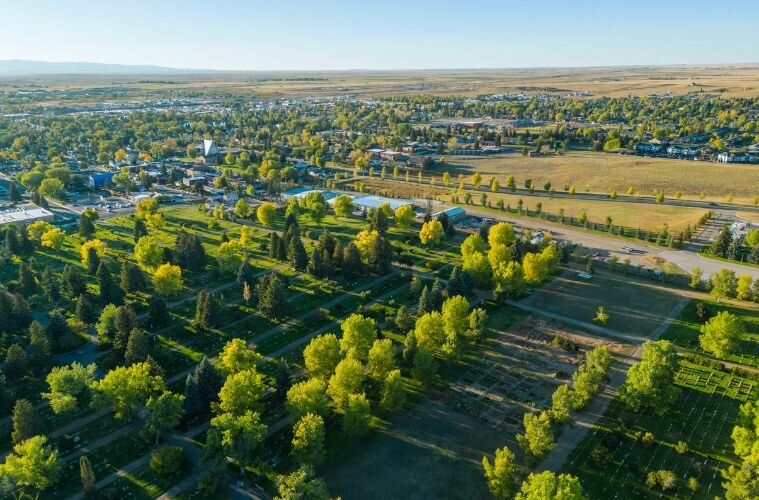
The Wyoming Supreme Court has ruled that Albany County lawfully used its zoning authority, rather than relying solely on environmental permitting, to protect the Casper Aquifer, the primary drinking water source for the City of Laramie and surrounding county residents. The case, Warren Livestock, LLC v. Board of County Commissioners, County of Albany, 2026 WY 76, upheld a 35-acre minimum lot size the county imposed within an Aquifer Protection Overlay Zone (APOZ) to limit septic system density near the aquifer.
Why the Court Upheld the Lot Size Requirement
Property owners and a livestock company challenged the 2023 APOZ amendments, arguing the county lacked authority to regulate for water quality purposes at all, since that role belongs to the Wyoming Department of Environmental Quality (WDEQ). The court disagreed, finding the county's zoning authority under state law, granted to protect public health, safety, and general welfare, reasonably extends to aquifer protection and does not conflict with WDEQ's separate permitting role. On the merits, the county pointed to its 2011 aquifer protection plan and later septic and nitrate-loading studies linking higher development density to elevated groundwater nitrate risk. Property owners countered with well-testing data showing nitrate levels well below the Environmental Protection Agency's 10 milligram-per-liter standard. The court found the county's evidence sufficient to meet the deferential arbitrary-and-capricious standard, noting that a difference of expert opinion does not make a zoning decision unlawful.
The Ruling Also Set a Broader Legal Standard
Beyond the aquifer question, the court used the case to hold for the first time that Wyoming's arbitrary-and-capricious standard of review, borrowed in part from federal administrative law, applies to zoning-type legislative action by local governments, not only to case-specific adjudicatory decisions. That procedural holding gives future zoning challenges in Wyoming a clearer standard to litigate against, regardless of subject matter. One justice dissented on the underlying authority question, arguing the state's Environmental Quality Act vests water-quality regulation exclusively with WDEQ and warning that allowing counties to zone for water quality could produce inconsistent local rules across the state.
Wyoming's approach is not unprecedented. Water access has already become a gating factor in site selection decisions nationally, well beyond drought-prone states like Arizona and Texas, and courts in New York and Connecticut have previously upheld comparable large-lot zoning specifically justified by aquifer and watershed protection. For companies evaluating land in aquifer-sensitive or water-stressed growth corridors, this ruling is a reminder that buildable density and lot economics can turn on local zoning decisions well before any water permit application is filed.
Companies that treat these constraints as an early planning input, rather than a downstream permitting hurdle, have generally fared better than those that don't. The underlying water-quality data disputes in this case, where both sides cited real testing results to reach opposite conclusions, also illustrate why location-specific water data matters more than aggregate figures when assessing site-level risk.


