

It's a reasonable assumption. It's also largely wrong.
A peer-reviewed study published this month in Nature Communications Sustainability mapped every major material recovery facility in the contiguous United States and compared their locations against census data, state recycling rates, and socioeconomic indicators. The conclusion is straightforward, and a little uncomfortable: whether your plastic waste actually gets recycled has less to do with intent than with how close you are to a facility that can handle it.
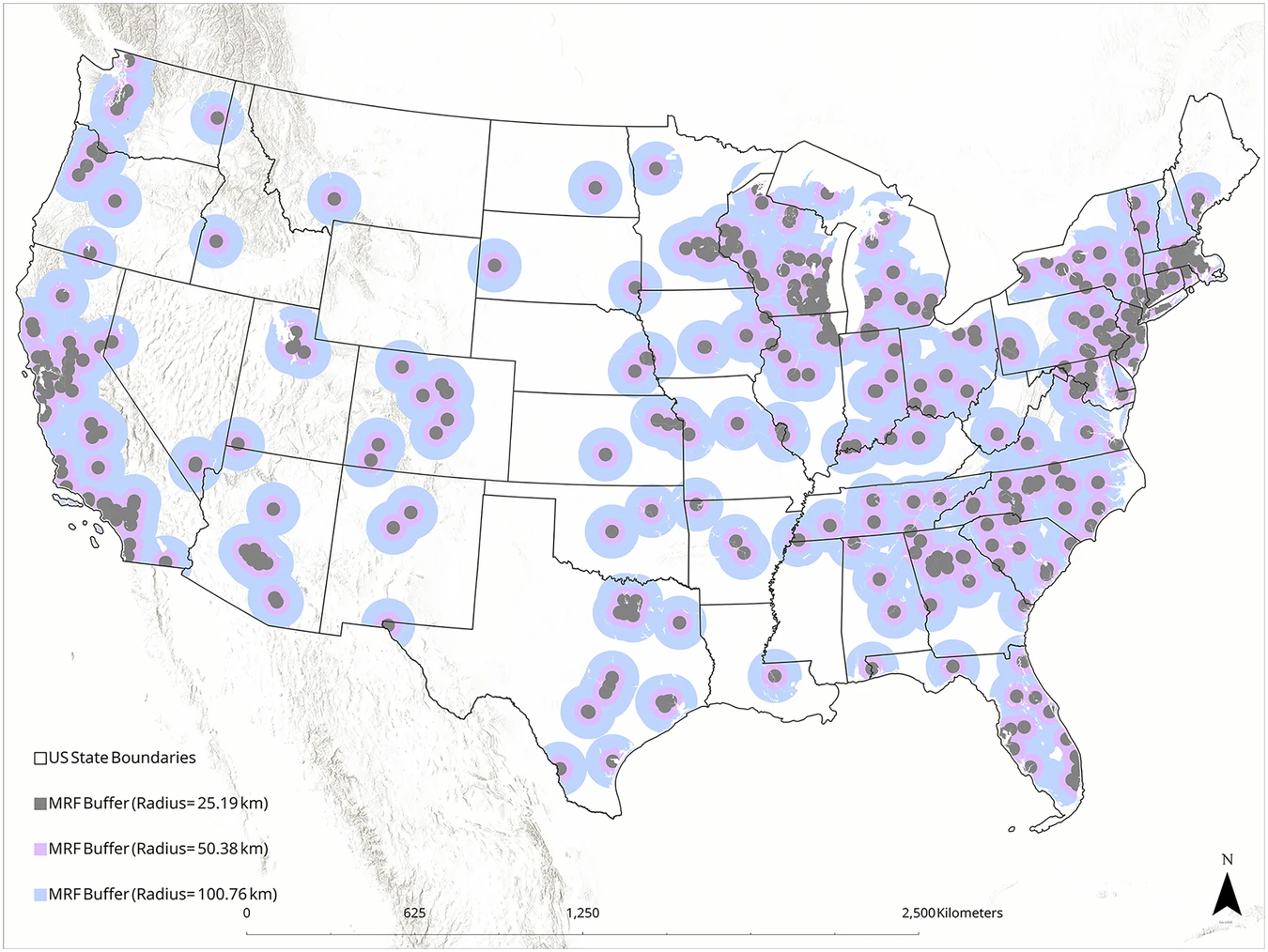
Researchers at the University at Buffalo identified all 419 large-scale industrial recycling facilities operating across the country and calculated the distance from nearly every building in the U.S. to its nearest site. The national average sits at about 31 miles. But that number flattens a story that looks very different depending on where you are.
Communities within reach of recycling infrastructure are 30 to 55% wealthier and 14 to 19% more college-educated than those without access. States like Texas, Alabama, Mississippi, Louisiana, and Georgia generate high volumes of plastic packaging waste but have far fewer facilities to process it. Wyoming has no large-scale plastic recycling facilities at all. Montana and North Dakota each have one.
"Our analysis suggests that recycling success is less shaped by plastic waste generation and more related to whether communities are given fair and equitable access to recycling systems," said Dr. John Atkinson, the study's corresponding author and the Scott and Coleen Stevens Chair in Engineering Sustainability at UB.
The California-Texas comparison is the most telling. The two states generate similar amounts of plastic waste per capita. California's facility network is extensive enough to achieve a 30% packaging recycling rate. Texas, with far fewer facilities spread across a much larger geography, lands at 5%.
Co-researcher Dr. Aditya Vedantam put it plainly: "Many people in the South and Southeast live in underserved recycling areas. They generate similar amounts of plastic waste but recovery and processing facilities are far away, which can make recycling much less feasible."
States with bottle bill programs—laws that attach a small refundable deposit to beverage containers—show recycling rates roughly double the national average. It sounds like a policy win, and in some ways it is. But the states without bottle bills that still perform well, New Jersey, Rhode Island, Maryland, all have one thing in common: dense, well-distributed infrastructure.
"Bottle bills show how public policy, when combined with infrastructure, can help improve recycling access," noted Dr. Janet Yang, a co-author on the study. The operative phrase there is combined with. Policy amplifies infrastructure. It doesn't replace it.
The researchers identified more than 1,000 U.S. regions without adequate recycling access. Sixty-four of those generate more than 5,000 tons of plastic packaging waste annually and sit more than 47 miles from the nearest facility. Those aren't fringe communities. Many of them are in industrial corridors where your suppliers operate.
If your Scope 3 waste diversion reporting assumes recycling performance is roughly uniform across your supply chain's geography, it probably isn't. Facility location—yours and your suppliers'—may be the single biggest variable in whether plastic waste actually gets recovered.
That's worth building into how you measure, report, and set targets going forward.


