
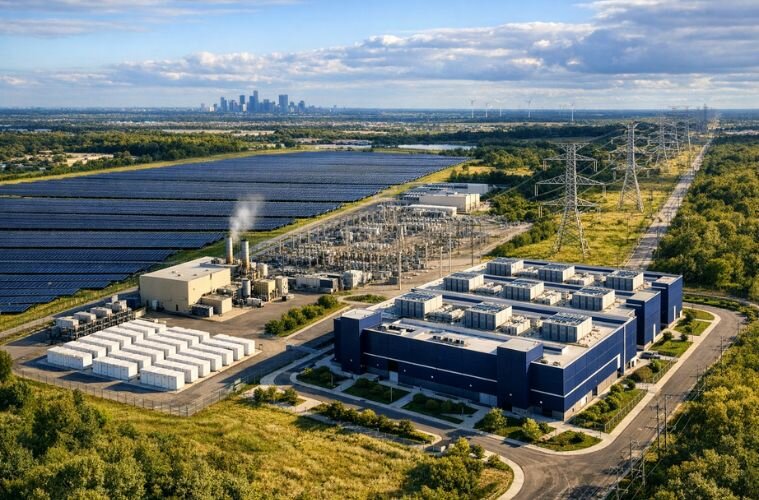
The leading edge of corporate energy procurement in 2026 is not a sustainability conversation. It is an infrastructure conversation. Hyperscalers are moving beyond financial hedges toward direct ownership of dispatchable generation assets, acquiring operating power plants and development sites, co-investing in small modular reactors, and funding dedicated off-site renewable plus storage projects designed to deliver firm power rather than financial settlement. What the largest buyers are doing is a leading indicator of what the contract market will look like for everyone else in the next procurement cycle.
FTI Consulting's 2025 M&A year review and 2026 outlook documents the shift explicitly: leading hyperscalers are moving beyond financial hedges toward direct asset ownership to secure reliability and capture restored tax benefits. They are funding the next generation of firm power by providing development capital for behind-the-meter and dedicated off-site resources. BloombergNEF's 1H 2026 outlook frames the market dynamic simply: for growth to return to the corporate clean energy procurement market, the sector needs clean, firm power supply options such as co-located solar and storage delivering at scale and at competitive prices.
What Firm Power Actually Means in the Current Grid Environment
Firm power is generating capacity that can be counted on to deliver when the grid needs it, not just when the sun is shining or the wind is blowing. In a grid environment where only 10% of new U.S. capacity additions through 2030 will be firm baseload, according to Deloitte's 2026 Power and Utilities Outlook, the scarcity of firm power is structural rather than cyclical. Organizations that secured long-term supply of firm, dispatchable generation in prior years, through gas tolling arrangements, nuclear power contracts, or hydroelectric agreements, are in a fundamentally different cost and reliability position than organizations whose procurement portfolios are concentrated in variable renewable energy without storage.
The PPA market is reflecting this. FTI documents a clear divergence: solar-plus-storage projects commanded significant premiums over pure-play solar in 2025, with investors aggressively targeting hybrid assets to capture the duck curve arbitrage in markets like CAISO and ERCOT where solar penetration is highest. Pure-play solar projects faced pricing pressure in congested hubs due to declining midday capture rates, while solar-plus-storage projects were repriced upward. For corporate buyers, the practical implication is that hybrid contracts with storage components are increasingly expensive relative to pure solar, but they are also increasingly necessary for organizations that need power when their facilities need it rather than when the grid happens to be oversupplied with solar generation.
How the Grid Congestion Problem Is Amplifying the Divide Globally
The firm power divide is not unique to the United States. Ember's analysis documents that in Europe, grid congestion in hubs such as Frankfurt, London, and Dublin has created 7 to 10 year connection queues, pushing new AI infrastructure investment toward regions with cleaner and more available capacity. Countries that are scaling renewables and accelerating grid upgrades are capturing disproportionate shares of new digital economy investment. Countries and companies that are not are facing a competitive displacement that compounds over time.
In a high-insolation region with adequate storage, Ember estimates that solar paired with batteries can already deliver round-the-clock electricity at approximately $104 per MWh, undercutting new coal and nuclear in those specific conditions. That number matters for corporate energy strategy because it establishes a benchmark for what firm renewable power costs at the technology frontier, which is the reference point against which organizational procurement decisions need to be evaluated. Organizations relying on legacy infrastructure without strict SLA delivery guarantees are overpaying for inferior products that fail to meet the performance of modernized alternatives.
What the Divide Means for Capital Planning and Competitive Position
PwC's 2026 Global M&A outlook for Energy, Utilities, and Resources reveals that skyrocketing power demand from AI and data centers, combined with the need for resilience, is accelerating M&A, with an increasing focus on localized generation and grid-connected assets. Deal value in the power and utilities sector increased approximately 57% from 2024 to 2025. The capital is moving toward assets that deliver firm power where demand is concentrated.
For corporate operations leaders and CFOs, the firm power divide translates into a capital planning question that most energy strategies haven't explicitly addressed: what % of your energy supply is firm, dispatchable, and deliverable on your operational schedule rather than on a grid-dependent or weather-dependent schedule? And for facilities where that % is low, what is the business case for securing a higher % through procurement action, on-site generation, or storage in the next 12 to 18 months before the contracting environment becomes more competitive and more expensive?
The week's coverage of energy procurement and contract exposure has traced multiple dimensions of how the contract market is under stress. The firm power divide is the forward-looking version of that story. The organizations that use the current disruption to upgrade their procurement position, securing firm, deliverable supply rather than financial instruments tied to variable generation, are the ones that will be on the right side of that divide when it becomes fully visible in operating results and capital valuations.


