
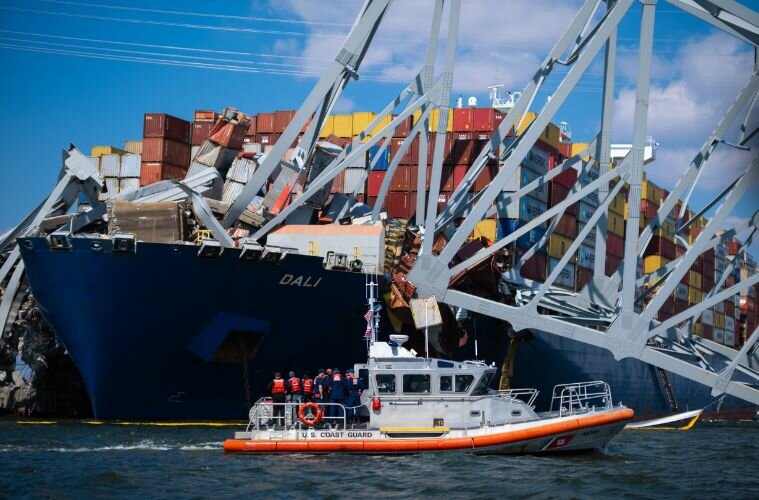
On April 8, 2026, a federal grand jury in the District of Maryland returned an 18-count criminal indictment against Synergy Marine Private Ltd., Synergy Maritime Private Ltd., and Technical Superintendent Radhakrishnan Karthik Nair. The charges connect directly to the March 26, 2024 allision in which the MV Dali struck the Francis Scott Key Bridge in Baltimore, killing six construction workers and closing the Port of Baltimore for 77 days. The indictment, filed under Case 1:26-cr-00118-JKB, alleges defendants caused at least $5 billion in gross pecuniary losses. Synergy Marine Group manages more than 700 vessels employing over 28,000 seafarers across 31 offices in 15 countries.
Flushing Pump Substitution Concealed from U.S. Coast Guard and Regulators Since 2020
The indictment's central technical allegation concerns how the MV Dali was supplying fuel to generators 3 and 4. The vessel's designed fuel supply system included redundant pumps with automatic restart capability and standby backups. Beginning around 2020, prosecutors allege Synergy substituted a maintenance flushing pump that lacked all three of those features. The modification was never approved by the vessel's classification society or Singapore, its flag state, as required under the International Safety Management Code and SOLAS. The same substitution was also used on at least two Synergy sister vessels.
That decision carried consequences well before the night of the allision. The MV Dali experienced a dual blackout while docked at the Port of Baltimore on March 25, 2024, roughly ten hours before departure. Neither the crew nor Synergy's shoreside managers reported that incident to the U.S. Coast Guard, the port terminal, or classification authorities. When the flushing pump was not manually restarted after a first power loss during the departure transit, generators 3 and 4 were starved of fuel and a second blackout followed at 1:27 a.m. on March 26. The ship struck the Key Bridge at 1:29 a.m.
Forged Electrical Inspection Certificates Submitted to Classification Society and NTSB
Beyond the fuel system substitution, the indictment charges Synergy with fabricating inspection certificates for vacuum circuit breakers and air circuit breakers on the MV Dali and at least two sister vessels. According to prosecutors, Nair coordinated the procurement of false certificates through outside vendors beginning in March 2020. Internal WeChat messages cited in the indictment show Nair requesting that a vendor provide a certificate without conducting an actual test, suggesting a payment of roughly $100. The certificates were later zip-tied to switchboard panels in the MV Dali's engine control room and submitted to the classification society during a Continuous Machinery Confirmatory Survey in 2023.
After the allision, Synergy submitted the same false certificates to NTSB investigators in June 2024 and to a federal grand jury in October 2024. Those submissions form the basis for two additional counts of obstruction of an agency proceeding and three counts of making false statements to federal authorities.
18 Counts Cover Conspiracy, Wrongful Deaths, Environmental Discharge, and Obstruction
The charges span six categories.
- Count 1 alleges conspiracy to defraud the United States and obstruct the U.S. Coast Guard.
- Counts 2 through 4 charge Ports and Waterways Safety Act violations for failing to report a hazardous vessel condition during three separate Port of Baltimore arrivals in 2023 and 2024.
- Counts 5 through 10 charge misconduct or neglect of ship officers resulting in the deaths of six individuals, each victim comprising a separate count.
- Counts 11 and 12 address obstruction of the NTSB investigation.
- Counts 13 through 15 charge false statement violations tied to certificate submissions.
- Counts 16 and 17 allege Clean Water Act violations for discharging pollutants and a harmful quantity of oil into the Patapsco River from the destroyed bridge, vehicles, and the MV Dali itself.
- Count 18 charges discharge of refuse under the Rivers and Harbors Act, covering at least 16,000 tons of steel, 10,000 tons of concrete, and seven vehicles deposited into the Patapsco without an Army Corps of Engineers permit.
"The collapse of the Francis Scott Key Bridge was a preventable tragedy of enormous consequence," Acting Attorney General Todd Blanche said. "This indictment is a critical step toward holding accountable those whose reckless disregard for maritime safety regulations caused this disaster. Six construction workers lost their lives, critical infrastructure was destroyed, pollutants were released into the Patapsco River and Chesapeake Bay, and the economic damage now exceeds five billion dollars. This department is committed to securing justice for the victims and ensuring those responsible are held to account."
Synergy Marine Group Disputes Charges and Cites NTSB Findings
Synergy Marine Group issued a statement on May 13, 2026 calling the charges baseless and disputing the DOJ's characterization of the flushing pump as relevant to the cause of the allision. The company said the MV Dali suffered a power loss due to a latent manufacturer defect, specifically a loose wire in the ship's electrical system, and that the vessel was approximately three ship lengths from the Key Bridge and traveling at roughly 8.5 knots when that loss occurred. Synergy contends that both the NTSB and independent maritime experts determined the allision was inevitable once that failure occurred.
The company stated that NTSB factual reports do not identify noncompliance with any applicable code, law, regulation, or builder's recommendation as the probable cause of the allision, and noted that the MV Dali and other Synergy-managed vessels held a near-flawless Port State Control record in the United States. Synergy said it and its employees cooperated fully and transparently with the NTSB investigation throughout the 20-month inquiry. The company said it intends to vigorously defend itself at trial and expressed confidence that the DOJ will not meet its burden of proof.


