

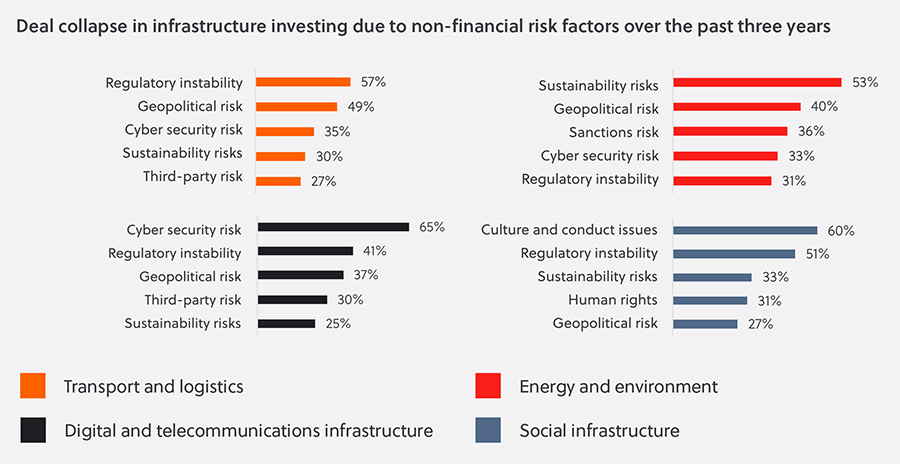
Sustainability risk is no longer a secondary consideration in energy and environmental transactions. It is increasingly reshaping how investors value assets, structure deals, and decide whether transactions move forward at all. New investor data shows that sustainability-related uncertainty is now contributing directly to failed deals, shifting the way capital is priced across the sector.
Over the past decade, sustainability-aligned energy projects often benefited from a valuation premium, supported by policy incentives, favorable financing conditions, and growing institutional demand. That dynamic is changing. Investors are now applying a more cautious lens as regulatory volatility, climate exposure, and stakeholder pressure introduce new forms of financial risk that are harder to model and insure.
For many investors, sustainability risk has moved beyond disclosure and reputation management into the core of financial due diligence. Regulatory reversals, inconsistent permitting frameworks, and uncertainty around long-term climate policy are affecting cash-flow assumptions and project timelines. As a result, sustainability risk is increasingly reflected in higher discount rates, more conservative revenue projections, and stricter financing conditions.
Climate-related operational risk is also playing a larger role in valuation discussions. Extreme weather events, insurance availability, and long-term asset resilience now factor into assessments of asset lifespan and return stability. Projects that once appeared economically sound are being reassessed as investors question whether expected returns adequately compensate for rising exposure to physical and regulatory risks.
In earlier market cycles, sustainability credentials were often associated with lower perceived risk and easier access to capital. Today, that assumption is being tested. While investor interest in energy transition assets remains strong, valuations increasingly reflect downside protection rather than upside potential.
This shift is particularly visible in transactions involving emerging technologies or projects dependent on long-term policy support. Carbon capture, storage, and other capital-intensive sustainability technologies face heightened scrutiny as investors question scalability, cost certainty, and regulatory durability. Where risk cannot be clearly quantified or mitigated, investors are more willing to walk away rather than accept compressed margins or extended payback periods.
The repricing of sustainability risk is contributing to a higher rate of deal collapse. Transactions are failing not necessarily because assets lack strategic value, but because the gap between buyer and seller expectations has widened. Sellers often price assets based on long-term sustainability narratives, while buyers focus on near- and medium-term financial exposure.
Financing conditions have also tightened. Lenders and insurers are exerting greater influence on deal outcomes by reassessing coverage terms, premium pricing, and covenant requirements linked to environmental and climate risk. In some cases, these constraints have undermined deal economics late in the process, leading to abandoned transactions after significant time and capital investment.
Importantly, this repricing does not signal a retreat from energy and environmental investment. Capital is still available, but it is becoming more selective. Investors are prioritizing projects with clear regulatory pathways, resilient operating models, and transparent risk allocation. Assets that integrate sustainability considerations early in project design and financial structuring are better positioned to attract investment under current market conditions.
Public and private capital are also responding differently. Long-term institutional investors with patient capital may tolerate higher sustainability-related uncertainty, while private equity and shorter-horizon funds are increasingly cautious about exposure that could erode near-term returns.
The shift from ESG premium to sustainability risk discount marks a maturation of the energy investment landscape. Sustainability is no longer viewed as an automatic value enhancer; it is treated as a material financial variable that must be managed with the same rigor as interest rate, currency, or supply-chain risk.
For developers and asset owners, the message is clear: sustainability narratives must be supported by durable economics, regulatory clarity, and operational resilience. For investors, the challenge lies in distinguishing between manageable sustainability risk and uncertainty that threatens long-term value. As the market recalibrates, the deals that move forward will increasingly be those where sustainability and financial fundamentals align.


