
Story one: The Trump administration has staked a significant portion of its economic agenda on bringing manufacturing jobs back to U.S. soil — through tariffs, trade pressure, and executive action on workforce training.
Story two: AI is disrupting white-collar work at an accelerating pace, displacing roles that were once considered safe while simultaneously creating demand for an entirely different class of technically skilled workers.
Story three: The U.S. skilled trades — the electricians, pipefitters, boilermakers, and controls technicians who build and maintain physical infrastructure — are facing a labor shortage so deep that it is now the primary constraint on both manufacturing growth and infrastructure decarbonization.
Here's what most boardroom conversations are missing: these three stories are not running in parallel. They are colliding. And the collision is most visible — and most consequential — in the infrastructure and industrial decarbonization space.
Let's be clear-eyed about what's actually happened since "Liberation Day" tariffs hit in April 2025.
The White House has kept a running tally of over 100 companies that have pledged to bring manufacturing back to American soil. The commitments are real and, in some sectors — particularly semiconductors, pharmaceuticals, and appliances — so is the follow-through. The Reshoring Initiative reported approximately 240,000 job announcements tied to reshoring and foreign direct investment in 2025.
But the broader manufacturing picture is harder to celebrate. The U.S. shed 83,000 manufacturing jobs during Trump's first year in office, and manufacturing employment fell every month of 2025 before a modest uptick in January 2026. As of December 2025, only 36% of companies responding to the ISM survey said they were planning to reshore production from abroad — while 64% said they had no such plans.
The reason companies aren't rushing back isn't simply politics or labor cost differentials. It's something more structural, and it's the part of this story that gets underreported.
When the Reshoring Initiative surveyed manufacturers about what they needed most from government to make reshoring viable, a skilled workforce ranked significantly higher than lower taxes, less regulation, or a lower dollar.
In other words, the companies that want to reshore are telling policymakers the same thing that infrastructure decarbonization project managers have been saying quietly for two years: we can fund the work. We can't find the people to do it.
Even if companies bring factories back to the United States, there might not be enough workers to staff them. That sentence — from the Washington Post's November 2025 analysis — is not a warning about the future. It is a description of the present.
The dominant workforce anxiety of 2025 and 2026 has been about AI displacing white-collar jobs. That anxiety is legitimate. In the first six months of 2025, nearly 78,000 tech job losses were directly attributed to AI, and companies using AI tools report that 49% have replaced workers as a result.
But here is the less-discussed flip side: the jobs that AI cannot touch are increasingly the jobs that don't have enough people in them.
Jobs in skilled trades "are the underdog and so AI-proof," according to Monster career expert Vicki Salemi. "They require physical presence, and they are less likely to be fully automated or offshored."
"Have a productive life in the trades that AI cannot destroy," former Chicago Mayor Rahm Emanuel told a Brookings Institution audience in February 2026.
The irony is sharp: AI is accelerating demand for physical infrastructure — data centers, grid upgrades, on-site generation, advanced manufacturing facilities — while simultaneously failing to address the shortage of the people needed to build it. AI has, ironically, accelerated the labor shortage in these industries. Everyone's building, wiring, and automating — but too few people know how to do the physical work that makes it possible.
Look at any major AI infrastructure project. Tesla's Gigafactories. Amazon's fulfillment centers. The hyperscale data center campuses going up across the Mountain West and Southeast. The automation looks futuristic, but the workforce keeping it running is deeply blue collar: electricians, robotics techs, maintenance mechanics, welders, HVAC specialists. The smarter the system becomes, the more skilled human hands it requires to stay functional.
This is the paradox AI has exposed: digital efficiency depends entirely on physical expertise.
On the union side alone, the electrical industry is losing about 20,000 electricians a year, and has 80,000 openings. "The demand for skilled labor is at an all-time high," said Ian Andrews, VP of labor relations at the National Electrical Contractors Association.
In the construction industry, the National Center for Construction Education and Research reports that 41% of the current workforce is expected to retire by 2031. Without replacement, that is not a gap. It is a structural collapse in execution capacity.
Industry analysts are now projecting a 30% skilled labor gap representing nearly 4 million unfilled positions over the next decade.
For industrial operations leaders and infrastructure decarbonization teams, the immediate math is stark: the U.S. currently faces a gap of 400,000 to 500,000 unfilled manufacturing jobs — a major obstacle to reviving domestic production even before factoring in new construction and clean energy demands.
And reshoring, if it accelerates as the administration intends, does not solve this problem. It compounds it. More factories coming back means more jobs to fill — jobs that require the same trades already in short supply for infrastructure and clean energy buildout.
One of the more important nuances in this story is that AI is not irrelevant to the trades. It is changing what those trades require — and organizations that understand this will hire and train differently than those that don't.
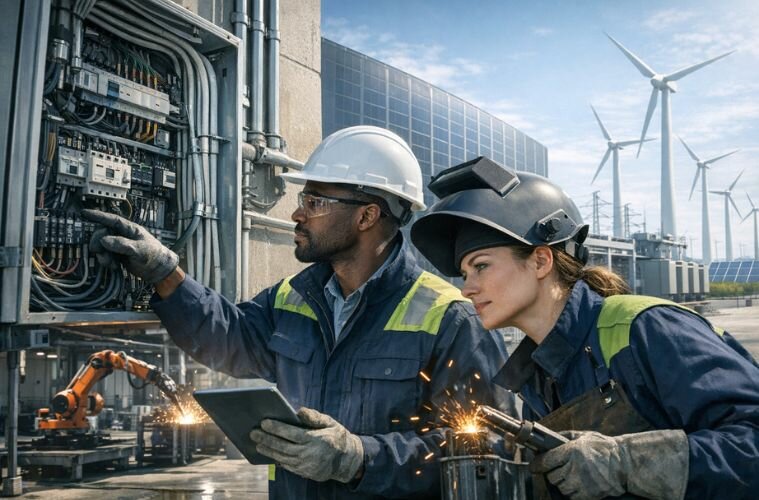
Modern HVAC systems use smart sensors. Electricians now work with IoT devices, renewable grids, and automation controls. Welders program robotic arms. Mechanics analyze data diagnostics. The modern tradesperson isn't just turning wrenches — they're operating in hybrid environments where technical and manual skills meet.
According to an NFPA survey, 95% of respondents agreed that AI already has a place in at least some day-to-day job functions in the trades. And AI is saving trade workers an average of 3.2 hours per week — more than 160 hours per year — by automating administrative work like generating work orders, tracking inventory, and ensuring code compliance.
AI-enabled manufacturing requires technicians, operators, and leaders who can interpret data, solve problems, and optimize processes in real time. Traditional hiring pipelines cannot supply these skills fast enough.
The implication is direct: organizations that are training trades workers for AI-assisted environments — not just traditional skills — will have a measurable advantage in both recruitment and retention. The trades are becoming knowledge-intensive, high-wage, and technologically demanding. That is a recruitment story waiting to be told more aggressively.
In April 2025, the Trump administration signed an Executive Order directing the Departments of Labor, Education, and Commerce to overhaul federal workforce training programs. The order directed those agencies to modernize, integrate, and re-align programs to address critical workforce needs in emerging industries, with a specific focus on registered apprenticeships as the mechanism for preparing workers for reshoring and re-industrialization.
This is the administration's most consequential workforce action — and the one receiving the least attention relative to tariff policy.
Whether this executive order translates into meaningful pipeline growth at the speed that infrastructure decarbonization and manufacturing reshoring require is an open question. Apprenticeship programs take years to produce journeymen. The policy levers being pulled in 2025 will not produce workers before 2028 or 2029 at the earliest.
Harry Moser, founder of the Reshoring Initiative, testified before the House Small Business Committee in November 2025 that the Department of Labor still overemphasizes the traditional four-year college path and needs to do far more to encourage technical training — particularly given that skilled workforce availability ranked as the top concern among manufacturers considering reshoring, above taxes, regulations, and every other policy variable.
The policy direction is right. The timeline is not aligned with the urgency.
For industrial operations and infrastructure leaders, the convergence of these three forces — the reshoring push, AI's disruption of white-collar labor, and the trades shortage — creates a specific set of decisions that need to be made now.
Every factory that comes back to U.S. soil requires electricians, pipefitters, and controls technicians to build it out and maintain it. Organizations executing infrastructure decarbonization projects are competing with semiconductor fabs, battery plants, and appliance manufacturers for the same trades workers. That competition is intensifying, not easing.
A software developer whose role was automated away does not become a licensed electrician in six months. The skills are not transferable on short timelines, and the training infrastructure does not currently exist at the scale needed to bridge the gap quickly. By 2030, 14% of employees globally will be forced to change their careers due to AI — but career transitions at that scale require training systems that are not yet in place.
Organizations that invest in tools, platforms, and workflows that make their existing trades workforce more productive — reducing administrative burden, improving job sequencing, enabling better diagnostics — will stretch their current labor capacity further than competitors relying solely on headcount. This is available now, and it compounds over time.
Smart reshoring initiatives are capitalizing on advanced manufacturing technologies that are making domestic manufacturing cost-competitive — and the companies leading this shift are the ones combining automation investment with workforce upskilling to make their operations resilient. Organizations partnering with community colleges, apprenticeship programs, and regional workforce development boards are not doing so out of civic generosity. They are building a supply chain.
There is a framing problem at the top of many organizations. Executives are watching the AI disruption story, following the tariff and reshoring headlines, and managing decarbonization commitments — and treating each as a separate strategic question.
They are the same question.
The throughline is this: the physical economy — the infrastructure, the factories, the grid, the buildings — needs to be built, upgraded, and maintained by people with skills that take years to develop, that AI cannot replicate, and that the current workforce pipeline is not producing fast enough to meet simultaneous demand from multiple competing national priorities.
The organizations that get ahead of this will not be the ones that wait for the federal apprenticeship pipeline to produce results, or for tariff policy to stabilize, or for AI to somehow solve a problem it is partly causing.
They will be the ones that make workforce development a line item in the capital plan — not the HR budget — and treat the availability of skilled trades the same way they treat commodity prices, grid reliability, and regulatory exposure: as a material operational risk that requires active management.


