
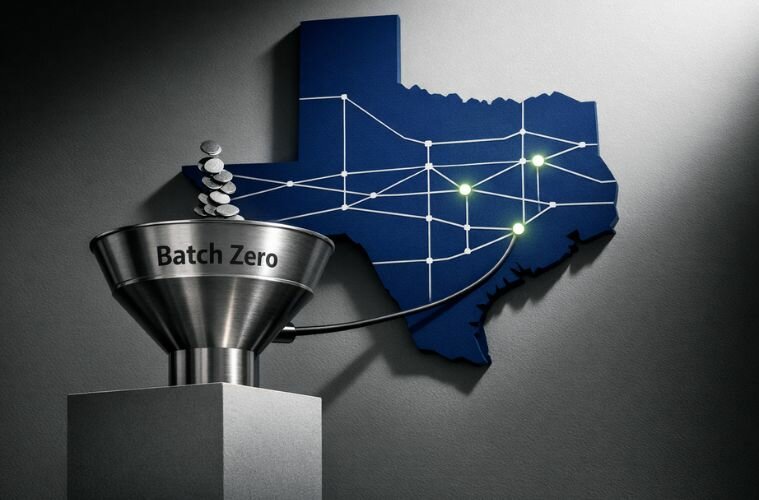
The Public Utility Commission of Texas approved a new interconnection framework on June 18 called Batch Zero, making the Electric Reliability Council of Texas (ERCOT) what it describes as the first Independent System Operator (ISO) in the nation to use a batch process for large electricity users, rather than reviewing projects one at a time. The framework applies to any facility, including data centers, that draws 75 megawatts (MW) or more at a single site, and it exists because the old process could not keep pace with demand. ERCOT is currently tracking more than 438,000 MW of large-load requests, nearly 89% of them from data centers, against an all-time statewide peak demand record of just 85,508 MW. That queue is more than five times ERCOT's own record peak demand, a gap that illustrates how speculative and early-stage many of these requests still are, and why finite transmission capacity now has to be allocated among competing projects rather than granted to whoever asks first.
What Batch Zero Actually Does
Rather than studying each project as it arrives, ERCOT will evaluate all qualifying Batch Zero applicants together in a single system-wide study, then allocate available transmission capacity among competing projects and produce a transmission construction plan to match. Projects that already completed prior interconnection studies or sit in approved regional planning work generally enter as base load, preserving their existing allocation. Everything else enters as studied load, meaning its final allocation depends entirely on how the group-wide study comes out. The rule aggregates demand across a single site, so a project cannot avoid the 75 MW threshold by splitting a campus across multiple meters. Batch Zero is explicitly transitional. ERCOT plans to run an ongoing batch process for future projects starting with Batch 1, which opens for applications in summer 2027.
The Deadlines Are Already Moving
Companies with projects anywhere near this threshold should already be tracking the calendar. The deadline for large-load entities to submit required technical studies and documentation was July 10, and the corresponding utility-side submissions to ERCOT were due July 24. A deficiency-cure deadline follows on August 31 for any project with incomplete dynamic load modeling data. ERCOT expects to notify applicants of their classification, base load, studied load, or excluded, by early August. ERCOT's public-facing timeline points to a final system-wide transmission plan sometime in fall 2027, though interim milestones in ERCOT's Planning Guide run earlier in the year, and developers face a further commitment deadline in June 2027 to post financial security proving they can actually build what they are requesting.
Getting a Faster Answer Costs Money and Flexibility
Batch Zero is not a free queue. Developers must provide financial security beginning at $50,000 per megawatt, which becomes part of the project's required interconnection commitment, with additional security required if specific system upgrades are identified for a project. The penalty for backing out is steep: if a customer withdraws its request or misses a milestone by six months, 80% of its posted financial security is retained to help offset transmission infrastructure costs through the utility's regulated investment process, with only 20% refunded. The framework also gives large loads two ways to move faster in exchange for accepting more risk. A Withdrawal-Limited Private Use Network lets a project pair with co-located generation and draw only incremental power from the grid, while a Provisional Controllable Load Resource designation lets a project accept curtailment during grid emergencies in exchange for a faster path to interconnection. Both options push developers toward the same choice already reshaping site selection elsewhere: bring your own generation and flexibility, or wait in a queue that is five times oversubscribed.
Why Texas Got Here First
Batch Zero implements Texas Senate Bill 6, signed in June 2025, and follows a direct order from Governor Greg Abbott on June 10 directing regulators to ensure large-load customers bear the costs of infrastructure built specifically to serve them, rather than spreading those costs to residential customers. Coincidentally, the Federal Energy Regulatory Commission (FERC) issued show-cause orders to the country's other major grid operators during the same period, directing them to justify or reform their own large-load interconnection rules, a process complicated in PJM's case by the governance crisis already underway at the country's largest grid operator. ERCOT sits outside FERC's jurisdiction entirely, since Texas built its grid specifically to avoid federal oversight. It arrived at a strikingly similar batch-study solution through state law instead.
Some Texas developers had already concluded the grid connection wasn't coming fast enough and permitted gigawatt-scale private generation instead. Batch Zero's new flexible pathways now formally recognize that workaround rather than compete against it. Electricity demand in Texas is already forecast to double within a decade. Batch Zero doesn't solve that scarcity. It just formalizes who has to wait for it to be resolved.


