
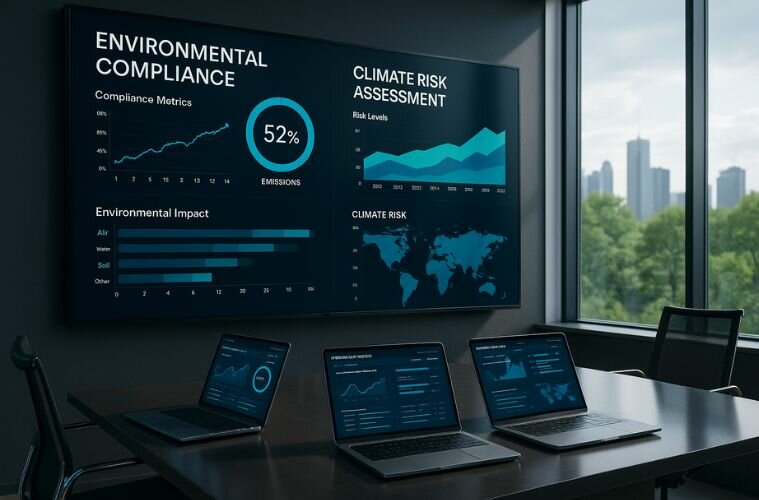
The market signals this shift clearly. Analysts project environmental compliance software will grow at 9–12% annually through 2031, with the broader compliance management market heading toward $75 billion by 2031. ESG software—fueled by investor demands and global reporting rules—continues expanding at 20%+ annual growth, even as federal policy shifts. EHS platforms, now intertwined with environmental and climate risk, are on track to approach $100 billion globally by the early 2030s.
This growth reflects a larger strategic reorientation: compliance systems are no longer just documentation hubs—they are becoming core infrastructure for resilience.
In 2025, the administration initiated what the EPA called the “biggest deregulatory action in U.S. history,” targeting rules across air pollutants, chemical releases, and permitting. Several sectors—including iron and steel, chemical manufacturing, and petrochemicals—received multi-year compliance extensions for hazardous air pollutant rules. Simultaneously, executive actions rescinded dozens of prior climate and environmental directives.
For corporate environmental teams, this did not simplify compliance. Instead, it introduced regulatory instability, creating scenarios where:
Two high-profile 2025 rulings further complicated corporate planning. Federal courts rejected attempts to halt offshore wind permitting, underscoring that legal oversight—not federal executive direction—may ultimately determine regulatory boundaries. Companies operating across energy, manufacturing, and infrastructure sectors now face a fragmented environment where rule changes, court decisions, and state actions move at different speeds.
Digital tools capable of tracking regulatory updates, documenting compliance history, and generating audit-ready records are becoming essential in this landscape.
As regulatory baselines shift, companies are leaning on software platforms that blend environmental data, operational risk modeling, and automated compliance oversight. The most significant developments entering 2026 include:
Compliance platforms now incorporate floodplain data, heat-stress forecasts, drought indicators, and wildfire probability maps. These tools allow teams to align compliance actions with facility-level resilience measures, supporting capital planning and insurance reviews.
EHS systems use machine learning to detect deviations in air emissions, water discharges, and equipment performance. This helps companies avoid violations before they occur, a critical capability when enforcement expectations fluctuate.
With the EU’s CSRD and multiple U.S. states advancing their own climate reporting frameworks, companies need systems that reconcile conflicting requirements and generate consistent disclosures.
Even as federal rules loosen, capital markets have not. Investors and insurers increasingly require auditable environmental data during underwriting, lending, and risk assessments.
As a result, digital compliance infrastructure is evolving into the operational “bridge” that connects environmental performance, regulatory obligations, and resilience planning.
The combined effect of deregulation, legal uncertainty, and climate volatility positions 2026 as the first year in which corporate resilience hinges as much on data integrity and digital systems as on physical infrastructure.
Key drivers include:
Companies entering 2026 with mature digital compliance systems will be more capable of navigating this uncertainty—demonstrating due diligence, protecting assets, and responding quickly to environmental or regulatory disruptions.
The first year of Trump’s presidency reshaped the regulatory landscape, but it also accelerated a corporate shift already underway. Businesses are recognizing that environmental compliance tools are no longer peripheral to operations—they are strategic systems that safeguard continuity.
By combining automated reporting, real-time monitoring, predictive analytics, and regulatory intelligence, digital compliance platforms now underpin how organizations understand risk, demonstrate accountability, and prepare for increasingly volatile conditions.
For companies planning for 2026 and beyond, resilience begins with the ability to see, measure, and manage environmental exposures in real time. Digital compliance tools are becoming the backbone that makes that possible.


