
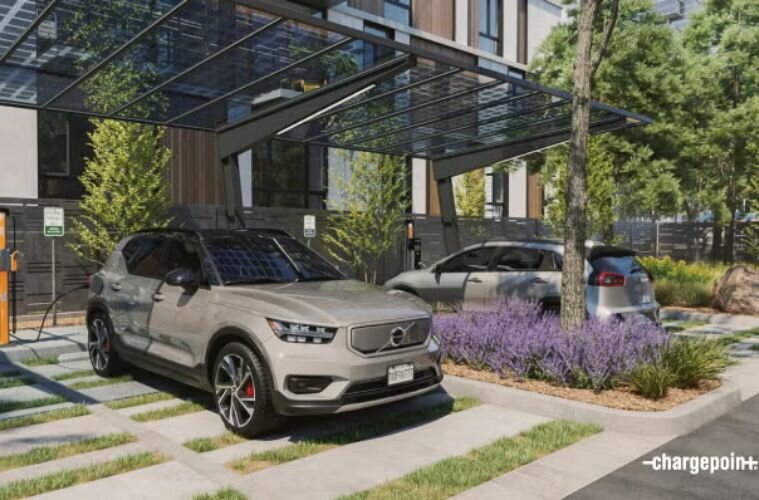
ChargePoint and OBE Power announced a partnership today to deploy approximately 2,500 EV charging ports at multifamily residential properties across North America, with installations beginning in 2026. The agreement expands on an existing relationship between the two companies in the hotel and hospitality sector, extending that same owned-and-operated model into apartment buildings and residential communities.
ChargePoint will serve as OBE Power's exclusive technology provider under the partnership, supplying chargers, software, and services. OBE Power will own the infrastructure, manage driver support, and handle energy cost reimbursement, carbon credit revenue, maintenance, insurance, and repairs, with no cost passed to the property owner or landlord.
The scale of the problem the partnership is targeting is well established but still underserved. According to the U.S. Department of Energy (DOE), approximately 80% of EV charging takes place at home. The challenge is that roughly 44 million Americans live in multifamily housing, and the majority of those residents have no reliable path to home charging. Most EV ownership assumptions, incentive programs, and charging network buildouts have been designed around single-family homeowners with dedicated parking and the ability to install their own equipment.
The Edison Electric Institute (EEI) reported the EV market set a record in 2024 with approximately 1.3 million units sold. While the market experienced a sharp drop in late 2025 due to policy shifts and the removal of certain federal purchase incentives, it remained the second-best year on record, with volume stabilizing and selective growth continuing into 2026.
The reason multifamily EV charging has been slow to scale is not primarily a technology problem. Landlords have lacked financial incentives, clear liability structures, and operational support. OBE Power's model addresses all three. By owning and operating the infrastructure itself, OBE Power assumes the capital cost and ongoing maintenance obligations, generating revenue through charging fees and carbon credit programs rather than charging the property owner. State incentive programs in Massachusetts, California, and New York have supported similar deployments, and the federal Investment Tax Credit (ITC) for EV charging equipment has added further economic support, though recent changes to the program's structure have introduced some uncertainty for smaller-scale asset classes.


