

The findings confirm what energy regulators and utilities have started to warn: AI’s next bottleneck isn’t silicon—it’s infrastructure.
The surge in AI-driven data centers is reshaping how the Department of Energy (DOE), the Federal Energy Regulatory Commission (FERC), and regional grid operators plan for capacity. Between 2024 and 2030, researchers project that even moderate growth could push AI server electricity demand to nearly 10% of total U.S. generation, rivaling the output of multiple nuclear plants.
Grid conditions will determine whether the sector’s carbon output rises or falls. The study modeled two future scenarios:
These projections align with DOE’s Electricity Market Reports and FERC’s recent warnings about transmission congestion in Texas and the Mid-Atlantic, where hyperscale facilities are driving record interconnection queues. Without coordinated grid upgrades, AI’s explosive load growth could undercut national decarbonization goals set under the Inflation Reduction Act.
“AI has moved beyond a software story—it’s a physical load that the grid must now absorb,” the Cornell team notes. Meeting that load requires tens of gigawatts of new transmission and massive renewable deployment, or the carbon intensity of the digital economy will surge just as other sectors are cutting back.
AI’s hidden environmental cost is water. The same study estimates that roughly 71% of AI’s total water footprint is indirect, embedded in the electricity used to power and cool servers. That means even facilities with “dry” or closed-loop cooling still depend on water-intensive generation sources upstream.
Hydropower regions, including California, Oregon, and Washington, deliver low-carbon electricity but suffer the highest evaporation losses per kilowatt-hour. In contrast, wind- and solar-rich states such as Texas, Nebraska, South Dakota, and Montana achieve both lower water intensity and lower emissions, making them prime candidates for sustainable AI expansion.
Researchers warn that decarbonizing through hydropower alone could exacerbate drought conditions across the West. “The next major water crisis may not come from agriculture or manufacturing—it may come from data,” one analysis concludes.
As drought resilience plans evolve in states like Arizona and Nevada, AI’s water demand will need to be included in resource-management modeling, not treated as an industrial outlier. Otherwise, digital infrastructure could quietly become a competing user in already over-allocated basins.
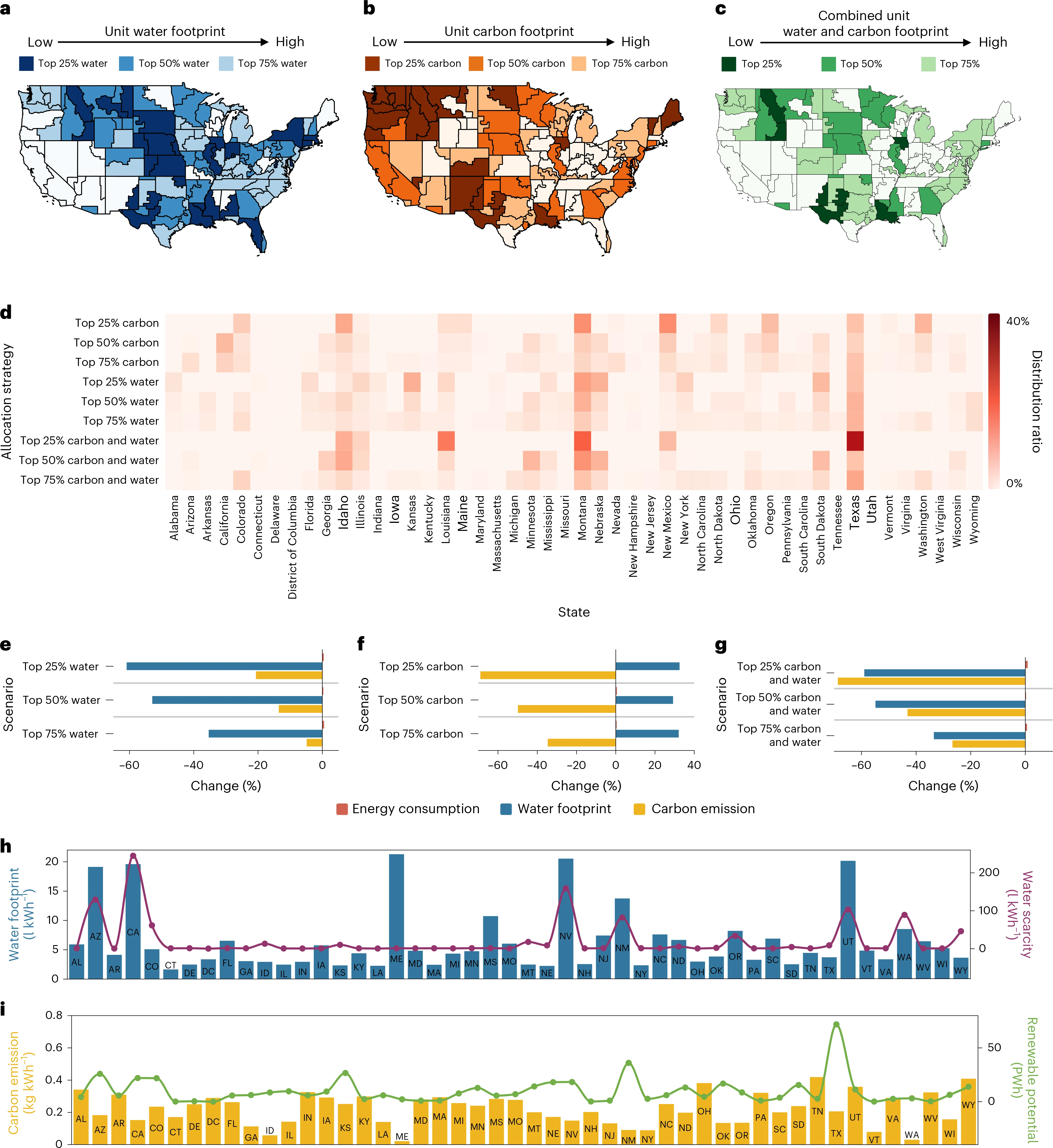
Advanced liquid cooling (ALC) and server-utilization optimization (SUO) can reduce energy and water use by about 10–30%, but the study finds that these gains are dwarfed by where data centers are built and how they connect to the grid.
Even under the best-case scenario—where efficiency measures, ideal siting, and rapid grid decarbonization align—AI servers would still leave 11 million metric tons of residual carbon emissions and more than 700 million cubic meters of annual water demand by 2030. Offsetting those footprints would require roughly 28 GW of new wind or 43 GW of solar capacity dedicated solely to AI operations.
That scale of buildout demands close coordination between technology companies, utilities, and state energy offices. Without it, AI growth could divert renewables from other sectors or trigger reliance on fossil generation to maintain reliability.
The authors call for a new governance model that recognizes AI as part of the national infrastructure ecosystem. Their recommendations include:
These steps would move beyond voluntary corporate pledges toward a measurable accountability gap the study warns must close quickly if AI’s net-zero ambitions are to remain credible.
The Nature Sustainability analysis makes one conclusion clear: sustaining intelligence will demand as much innovation in energy and water management as in machine learning itself.


