
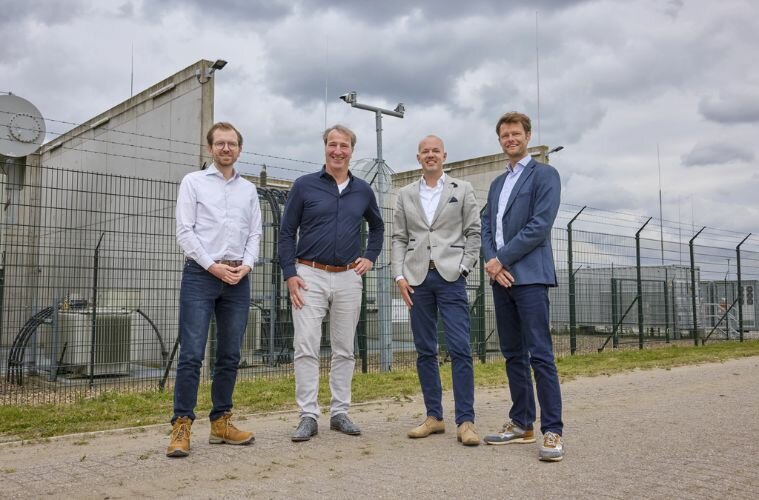
Windpark Zeewolde, a 322-megawatt (MW) onshore wind farm in the Dutch province of Flevoland and the largest of its kind in Europe, has partnered with Dutch storage developer Elestor to install a 20 MW hydrogen-iron flow battery capable of storing between 200 and 800 megawatt-hours (MWh) of electricity, a duration window of 10 to 40 hours depending on final configuration. Most utility-scale lithium-ion batteries deployed today run 2 to 4 hours, occasionally stretching to 6 or 8. This system is being built for overnight storage and multi-day wind lulls, the kind of duration the long-duration energy storage (LDES) market has struggled to make commercially viable at scale.
The Technology Trades Battery Cells for Bigger Tanks
Elestor's hydrogen-iron flow battery works differently from a conventional lithium-ion pack. During charging, electricity splits water to produce hydrogen, which then reacts with an iron-based electrolyte; discharging reverses that reaction to send electricity back to the grid. Because the energy itself is stored in liquid electrolyte held in external tanks rather than inside the battery cells doing the power conversion, adding storage duration is mostly a matter of adding more tank volume rather than more expensive battery stacks. Elestor says the underlying technology can span 8 to 150 hours of duration; this specific deployment is calibrated to the 10-to-40-hour range Zeewolde needs. The company also relies on materials, hydrogen, iron, and water, that are abundant and inexpensive compared to the lithium, nickel, cobalt, and graphite that lithium-ion systems depend on, sidestepping a supply chain that has become a genuine strategic concern for battery buyers.
The Real Driver Is a Grid That Can't Absorb the Power Already Being Generated
The project is as much a response to Dutch grid congestion as it is a storage breakthrough. In a February 2026 letter to parliament, Climate Minister Sophie Hermans disclosed that regional grid operators' waiting lists held more than 14,000 requests for electricity offtake capacity totaling roughly 9 gigawatts (GW), while national grid operator TenneT's own waiting list held 212 requests totaling 38 GW. Generation-rich regions running into transmission ceilings is not a uniquely Dutch problem, but the Netherlands is one of the clearest cases of it playing out today. Storage lets Zeewolde bank wind generation it cannot immediately export and release it later, when the existing grid connection has room, rather than waiting years for transmission upgrades that may not arrive on the timeline the wind farm needs.
The Project Is Rebranding Around Flexibility, Not Just Generation
Zeewolde, which is owned by more than 200 local farmers, residents, and entrepreneurs, plans to rebrand as Energiehub Zeewolde as the storage system comes online, reflecting a shift from simply exporting wind power to actively managing when that power reaches the grid. The rollout is phased: Elestor will install a smaller pre-commercial unit first to prove out performance, with the full 20 MW system targeted for 2031. The partnership follows a $34 million (€30 million (EUR)) Series A funding round for Elestor led by Equinor Ventures, with Vopak Ventures, Invest-NL, and several other investors participating, capital that reflects genuine institutional appetite for long-duration storage technology beyond lithium-ion.
The Same Math Applies Anywhere Renewable Buildout Has Outrun the Wires
The underlying dynamic extends well past one Dutch wind farm. Renewable curtailment in PJM alone reportedly increased nearly sixfold in 2024, and similar transmission bottlenecks are showing up in Texas, California, Germany, and Australia. Short-duration lithium-ion storage remains well suited to hourly load shifting, but it was never designed to solve a multi-day transmission constraint. For utilities and grid operators increasingly limited not by how much renewable power they can generate but by how efficiently they can move it, that gap is exactly what projects like Zeewolde are built to close. Utilities that once bought generation capacity are increasingly buying flexibility instead, and duration, not megawatts, is becoming the number that matters most.


