
The challenge is that these materials are difficult to fine-tune. Small changes in their structure can affect how they handle light and electricity, but it is not always clear which change is causing which effect.
Researchers at Hanbat National University in South Korea have developed a model that could make this design process easier. Their work focuses on the thin organic layers inside 2D perovskites, known as spacer layers, and how these layers influence the material’s behaviour.
In simple terms, 2D perovskites are made of stacked layers. The inorganic layers are the parts that mainly handle light and electrical activity. The organic spacer layers sit between them and affect how those layers interact.
One important part of this process involves excitons. These are pairs of charged particles, an electron and a hole, that form when the material absorbs light. Excitons play a major role in how well a material can be used in LEDs, solar cells and similar devices.
Until now, it has been hard to study the spacer layers clearly. When researchers change the spacer material, they often change several things at once. That can alter both the spacing between the layers and the structure of the material itself. As a result, it becomes difficult to know whether a change in performance is caused by the spacer, the structure, or a mix of both.
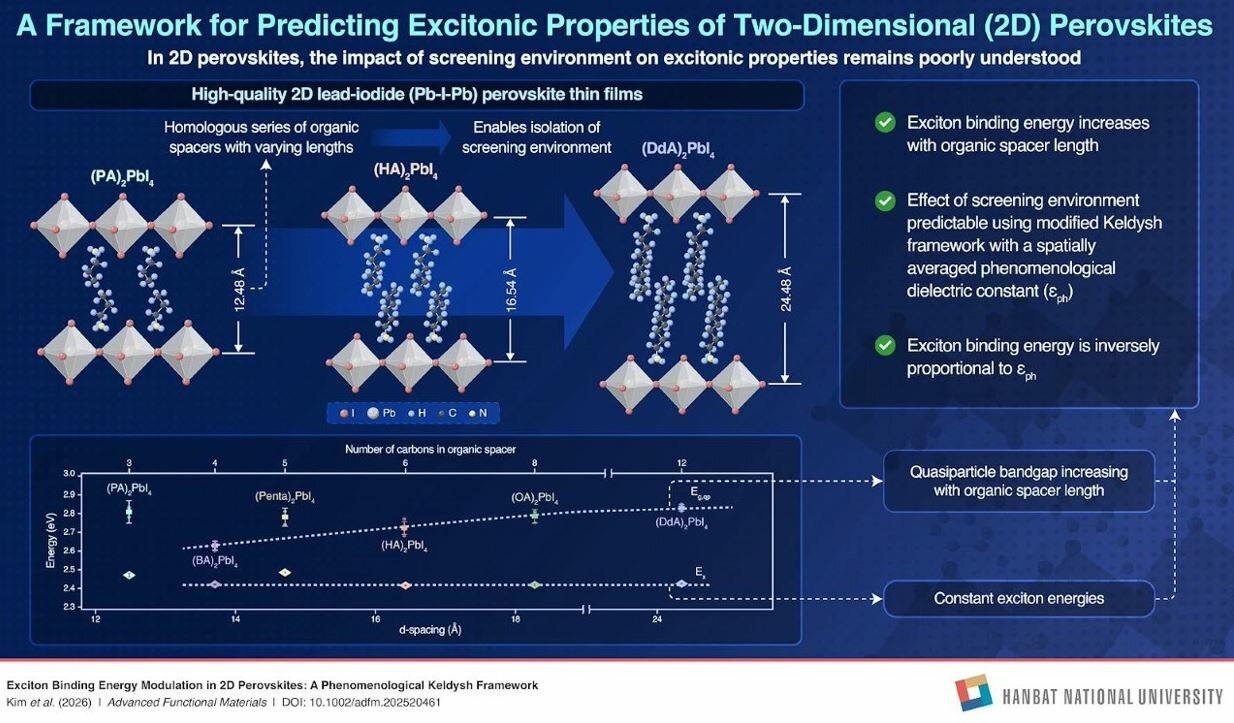
The Hanbat team, led by Professor Ki-Ha Hong from the Department of Materials Science and Engineering, set out to separate those effects. They studied a related set of 2D lead-iodide perovskites where the main inorganic structure stayed almost the same. This allowed them to focus more directly on what happened when the length of the organic spacer layer changed.
The researchers made thin films using organic spacers with similar chemical end groups but different chain lengths. By changing the length of those chains, they could adjust the distance between the inorganic layers without heavily distorting the material’s structure.
They then measured how the materials behaved using several spectroscopy techniques. These tests helped them compare the material’s bandgap, which is linked to how it handles electrical energy, with its exciton energy, which is linked to how it absorbs light.
The results showed a useful pattern. As the spacer layers became longer, the quasiparticle bandgap increased. However, the exciton energy stayed almost the same.
That difference is important because it suggests the spacer layer has a strong effect on the material’s electrical behaviour, even when its light-absorption energy changes very little. It also showed that longer spacers increased exciton binding energy, which describes how strongly the electron and hole stay connected after light is absorbed.
For engineers and materials teams, this gives a clearer design route. Instead of testing spacer materials mainly by trial and error, they may be able to use spacer length as a more predictable way to adjust how a 2D perovskite performs.
The team also tested how well an existing theory, called the Keldysh model, could explain the results. This model is often used to describe excitons in very thin materials. While it explained some of the behaviour, it did not fully match what the researchers observed.
To improve the fit, the team added a new function that takes into account the real thickness of the organic spacer layers. With that adjustment, the model matched the experimental data more closely.
The result is a more practical tool for predicting how 2D perovskites will behave before they are built into a device. For companies and research groups working on perovskite LEDs, solar cells, sensors or display technologies, this could support faster and more focused material development.
The study does not remove all of the challenges around perovskite devices, including manufacturing, long-term reliability and commercial scale-up. However, it gives researchers a clearer way to connect molecular design with material performance.
The research was published in Advanced Functional Materials after becoming available online in December 2025.


